| Iron-Core Linear Motors |
Coil assembly with an iron core interacting with a permanent-magnet track. |
Approximately 50–2,000 N per motor, depending on motor length, winding, and thermal design. |
Commonly 1–5 m/s; higher speeds are possible in optimized systems. |
High force density and strong acceleration; cogging force may require compensation or suitable control tuning. |
Natural air
Forced air
Liquid cooling
|
Machine tools, semiconductor equipment, precision stages, inspection systems, and industrial automation. |
Force ripple, thermal stability, magnet-track accuracy, encoder compatibility, and available stroke lengths. |
| Ironless Linear Motors |
Coil assembly without iron teeth, operating between permanent-magnet arrays. |
Approximately 10–800 N per motor, depending on the active length and current rating. |
Commonly 1–4 m/s; suitable for smooth, high-dynamic motion. |
Very low cogging and low moving mass; provides smooth motion and good synchronization performance. |
Natural air
Forced air
Liquid cooling
|
Optical inspection, laser processing, electronics assembly, medical equipment, and precision positioning. |
Continuous force at the required duty cycle, thermal expansion, coil stiffness, cable management, and magnetic shielding. |
| Tubular Linear Motors |
Cylindrical permanent-magnet mover and tubular stator with a compact coaxial structure. |
Approximately 20–1,000 N per motor, depending on diameter, stroke, and winding configuration. |
Commonly 0.5–3 m/s. |
Compact radial envelope, low mechanical transmission backlash, and suitability for direct reciprocating motion. |
Natural air
Forced air
|
Pick-and-place modules, packaging machinery, valve actuation, medical devices, and compact automation equipment. |
Sealing requirements, shaft guidance, allowable side load, stroke-to-length ratio, and protection against contamination. |
| Voice-Coil Linear Motors |
Short-stroke moving coil and permanent-magnet assembly with a simple electromagnetic structure. |
Typically below 200 N; short-duration peak force can be substantially higher than continuous force. |
Usually below 1 m/s, depending on stroke, load, and control bandwidth. |
Short stroke, low friction, rapid response, and excellent small-motion control; normally requires an external position sensor. |
Natural air
Conductive housing
|
Camera focusing, optical shutters, haptic mechanisms, micro-positioning, lens movement, and precision actuators. |
Stroke, peak and continuous force, thermal time constant, moving mass, sensor integration, and mechanical guidance. |
| Flat Linear Motors |
Flat coil or magnet-track arrangement designed for planar or single-axis direct drive. |
Approximately 20–1,500 N per motor, depending on active area and cooling method. |
Commonly 0.5–3 m/s. |
Space-efficient profile with direct-drive operation; performance depends strongly on air gap and alignment. |
Natural air
Forced air
Liquid cooling
|
Conveyor systems, material handling, inspection lines, assembly stations, and multi-axis automation. |
Magnet-track modularity, parallelism, mounting tolerance, cable routing, contamination control, and motor synchronization. |
| Linear Motor Modules |
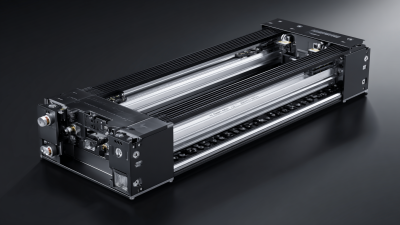
Integrated linear motor, guideway, encoder, carriage, and optional protective cover or cable carrier. |
Approximately 50–2,000 N per axis, based on module size and drive configuration. |
Commonly 0.5–2.5 m/s. |
Factory-integrated motion axis that reduces mechanical integration work and simplifies machine design. |
Natural air
Forced air
|
Cartesian robots, dispensing systems, screw replacement, testing equipment, and automated production lines. |
Guideway load rating, straightness, repeatability, encoder resolution, ingress protection, and installation documentation. |
| Planar Motor Systems |
Two-dimensional magnetically actuated platform enabling movement in two axes, often with vertical or rotational functions. |
Application-specific; commonly designed for light-to-medium payloads rather than maximum thrust. |
Commonly 0.1–1 m/s, depending on payload and control architecture. |
Contactless multi-axis motion with flexible routing and the potential for independent movers on one work surface. |
Natural air
Forced air
|
Clean manufacturing, semiconductor handling, laboratory automation, sorting, and high-flexibility assembly. |
Payload capacity, mover tracking, surface flatness, control software, position feedback, and system-level integration support. |
| Linear Motor Gantry Systems |
Multi-axis structure combining linear motors with precision guides, gantry beams, encoders, and motion controllers. |
Approximately 100–5,000 N per axis, depending on span, payload, and acceleration requirements. |
Commonly 0.5–3 m/s. |
Suitable for large working envelopes, synchronized axes, high throughput, and direct-drive precision motion. |
Forced air
Liquid cooling
|
Large-format machining, laser cutting, dispensing, inspection, electronics manufacturing, and automated handling. |
Gantry squareness, structural stiffness, thermal compensation, cable-chain design, vibration control, and commissioning service. |
| Custom Linear Motor Assemblies |
Application-specific stator, mover, magnet track, feedback, housing, and drive package. |
Defined by the buyer’s force, duty-cycle, stroke, and environmental requirements. |
Defined by load, acceleration, stroke, and process cycle time. |
Can be optimized for unusual envelopes, vacuum use, cleanroom operation, high acceleration, or special mounting constraints. |
Natural air
Forced air
Liquid cooling
|
Special-purpose machinery, vacuum equipment, aerospace testing, research systems, and customized production equipment. |
Engineering capability, prototype validation, test reports, drawing control, change management, spare parts, and export compliance. |