
Choosing the right Api 6a Seal Kit is a pressure-control decision, not a simple purchasing task. A mismatched seal can leak during testing, installation, or well intervention. Small details matter: bore size, temperature rating, elastomer compound, pressure class, and service fluid compatibility.
The International Energy Agency’s Oil 2024 report expects global oil demand to approach 105.6 million barrels per day by 2029. That outlook increases pressure on operators to extend equipment reliability and reduce unplanned downtime. API Specification 6A and ISO 10423 define critical requirements for wellhead and Christmas-tree equipment. However, compliance alone does not guarantee a suitable kit. Storage conditions, installation practice, and actual field chemistry still influence performance.
Mike Sommers, API President and CEO, has stated, “API standards are the cornerstone of safety and efficiency.” That principle applies directly to seal selection. The seven tips in this guide connect standards with practical inspection: verify the equipment identification, match the pressure and temperature envelope, confirm material compatibility, check traceability, inspect packaging, review shelf life, and validate supplier competence.
Look closely.
A seal kit should arrive clean, labeled, and protected from heat, sunlight, moisture, and ozone. One overlooked detail can defeat an otherwise careful specification. This guide is not perfect; field conditions vary, and catalog descriptions may hide important limitations. Engineers should compare certificates, drawings, maintenance records, and manufacturer data before approval. Reliable decisions come from evidence, not attractive pricing or familiar packaging.
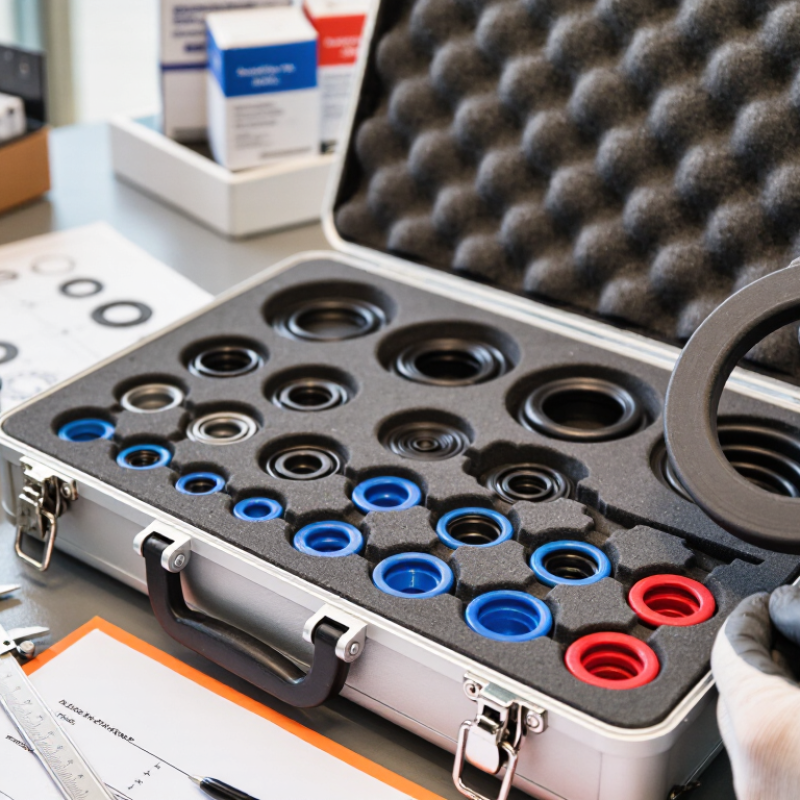
Choosing the right API 6A seal kit starts with pressure, not appearance. API 6A equipment may have a working pressure rating from 2,000 to 20,000 psi WP. WP means working pressure, not the temporary test pressure. Always match the kit with the actual equipment rating shown on its nameplate and documentation.
Tip 1: Confirm the pressure class. A 10,000 psi WP assembly needs seals rated for that service. Never treat a lower-rated seal as an economical substitute.
Tip 2: Check temperature limits. Hot fluids can reduce seal flexibility and shorten service life.
Tip 3: Identify the fluid. Sour, abrasive, or chemically aggressive media may require different elastomer compounds. Small details matter.
Tip 4: Measure the groove carefully. Record diameter, cross-section, and gland condition before ordering.
Tip 5: Review material compatibility with pressure cycles. Repeated loading can expose weaknesses that a static test misses.
Tip 6: Verify the kit’s traceability, inspection records, and applicable API 6A requirements. Reliable documentation supports safer maintenance decisions.
Tip 7: Compare the kit with the original equipment drawing, not memory. I have seen clean-looking replacements fail because one dimension was slightly wrong. That is easy to overlook. Consider it a reminder to slow down, especially near 20,000 psi WP.

7 Tips to Choose the Right API 6A Seal Kit?
Match Seal Materials to Temperature Classes from −60°F to 350°F
Selecting an API 6A seal kit begins with the equipment’s temperature class, not the cheapest material. At −60°F, some elastomers stiffen and lose sealing flexibility. At 350°F, heat can cause compression set, cracking, or accelerated chemical aging. A seal may look perfect during installation. It can still fail after cycling.
For low-temperature service, choose compounds qualified for cold flexibility and repeated pressure changes. NBR may suit selected applications, but its limits depend on the compound and fluid. HNBR often offers stronger heat and mechanical resistance. FKM can handle many high-temperature fluids, yet it is not suitable for every chemical or low-temperature condition. PTFE-based elements can reduce friction, but installation and energizing design need careful review.
Do not match materials by temperature alone. Check produced fluids, additives, gas content, pressure, decompression risk, and sour-service requirements. Confirm the seal kit’s documented qualification for the exact API 6A equipment and temperature class. I have seen teams trust a familiar material without checking fluid compatibility. That shortcut fails. Review the seal cross-section, backup rings, surface finish, and storage age before installation. A small scratch matters. Test records, batch traceability, and clear temperature ratings provide stronger confidence than a generic chart. I still recheck the lower limit after transport and storage, because cold-soaked seals can behave differently during startup.
| Tip | Selection Dimension | Typical API 6A Application Requirement | Recommended Seal Material | Typical Temperature Capability* | Main Advantages | Important Limitations |
|---|---|---|---|---|---|---|
| 1 | Define the complete temperature envelope | Select for both the minimum start-up or ambient temperature and the maximum continuous or excursion temperature. A −60°F to 350°F envelope is approximately −51°C to 177°C. | Low-temperature FKM, qualified HNBR, or a suitable PTFE-based seal design | Material-dependent; do not use the polymer's maximum laboratory temperature as the pressure-boundary rating. | Reduces hardening, shrinkage, extrusion, and leakage caused by thermal cycling. | Actual limits vary with compound, hardness, pressure, gap, gland design, cycling, and sour-service qualification. |
| 2 | Match the API 6A temperature class | Common API 6A temperature classes include K, L, P, R, S, T, U, and V. The equipment class is separate from the seal compound rating. | Choose a seal compound whose qualified range covers the equipment class and actual operating envelope. | For reference, Class L is approximately −51°C to 180°C, or −60°F to 356°F, subject to the applicable API 6A edition and product design. | Prevents selecting a kit based only on nominal equipment temperature markings. | API 6A equipment temperature class does not automatically qualify every elastomer installed in the equipment. |
| 3 | Identify the fluid and chemical exposure | Consider crude oil, natural gas, condensate, drilling fluids, completion fluids, water, methanol, H₂S, CO₂, and cleaning chemicals. | FKM for many hydrocarbon services; HNBR for oil, gas, abrasion, and wider mechanical durability; EPDM for hot water or steam when hydrocarbons are absent. | FKM: typically about −20°F to 400°F; HNBR: typically about −40°F to 300°F; EPDM: typically about −65°F to 300°F. | Improves resistance to swelling, softening, decompression damage, and chemical attack. | EPDM is generally unsuitable for petroleum oils and many hydrocarbon fluids; FKM may have limited low-temperature flexibility. |
| 4 | Check pressure and extrusion risk | Review working pressure, pressure cycling, extrusion gaps, clearances, backup rings, and rapid gas decompression exposure. | HNBR or qualified FKM with anti-extrusion backup rings; PTFE-based seals for selected high-temperature or low-friction designs. | HNBR and FKM commonly support demanding oil-and-gas sealing, but pressure limits must be established by the specific design. | Better resistance to extrusion, wear, and cyclic pressure damage. | Temperature capability alone cannot confirm pressure suitability; gland geometry and backup-ring design are critical. |
| 5 | Evaluate sour-gas and decompression requirements | For H₂S-containing service, verify the applicable NACE/ISO sour-service requirements, hardness limits, and rapid gas decompression performance. | Sour-service-qualified HNBR or FKM compound; use a qualified PTFE-based design where appropriate. | Use only the range stated on the compound qualification and test documentation. | Reduces blistering, cracking, explosive decompression, and loss of sealing force. | A general-purpose elastomer with the same temperature range may not be suitable for sour gas or rapid decompression. |
| 6 | Select the correct seal architecture | Confirm whether the kit uses O-rings, T-seals, lip seals, chevron seals, metal-to-metal seals, energizers, and backup rings. | Elastomer O-rings or T-seals for many static applications; PTFE-based seals for low friction, chemical resistance, or extended temperature service. | PTFE compounds are often usable across approximately −100°F to 500°F, but the complete seal design may have a narrower range. | Correct geometry improves sealing force, installation reliability, and resistance to extrusion. | PTFE has limited elastic recovery compared with elastomers and may require an energizer or precision gland design. |
| 7 | Verify traceability and installation controls | Check compound identification, batch traceability, shelf life, storage conditions, seal dimensions, hardness, lubrication, and installation procedures. | Use a documented, application-specific compound and a complete kit with compatible backup rings and installation components. | The kit should be stored and installed within the supplier's documented limits; avoid prolonged heat, ozone, sunlight, and chemical contamination. | Improves repeatability and reduces failures caused by incorrect dimensions, aging, contamination, or assembly damage. | A correctly selected material can still fail if the seal is out of tolerance, expired, damaged, or installed incorrectly. |
Choosing an API 6A seal kit starts with the PSL requirement, not the lowest price. API Specification 6A defines PSL 1 through PSL 4 as increasing levels of manufacturing control, inspection, and verification. Confirm the required PSL from the equipment datasheet, purchase order, and operating environment. Do not assume a higher pressure rating automatically means PSL 3 or PSL 4. That shortcut can create a serious documentation gap. Check temperature, fluid type, sour-service exposure, pressure cycles, and seal configuration. Small details matter.
Request traceable material certifications for every pressure-containing or sealing component. The certificate should identify the heat number, material grade, chemical composition, mechanical results, heat treatment, and applicable nondestructive examination. Match each number to the component, packaging, and inspection record. ISO’s Survey 2023 reported 1,265,216 ISO 9001 certificates worldwide, showing how widely controlled quality systems are used. Certification alone, however, is not proof of conformity. A neat certificate file can still hide a broken traceability chain. Review revision levels and authorized signatures. Keep the original records. Ask whether replacement elastomers have batch information and storage history. This step is often underestimated. Field teams may discover missing documents only during installation, when time is expensive and choices are limited. Independent review can expose unclear material substitutions before the kit reaches the wellsite.
API 6A nominal working-pressure classes range from 2,000 to 20,000 psi. Select a seal kit that matches the equipment pressure class, temperature range, seal material, and documented PSL requirements. PSL 1–4 defines increasing levels of product and quality-control requirements, so verify the applicable PSL and traceable material certifications before installation.
Pressure classes shown: 2,000, 3,000, 5,000, 10,000, 15,000, and 20,000 psi, equivalent to approximately 13.8, 20.7, 34.5, 69.0, 103.4, and 137.9 MPa. Pressure class and PSL are separate selection criteria; both should be confirmed against the equipment documentation and material certificates.
Choosing an API 6A seal kit starts with the ring-gasket profile, not the box label. Match the flange groove and pressure class with the drawing or certified equipment record. API Spec 6A, 21st Edition, and ISO 10423:2022 define dimensions, materials, and performance requirements for wellhead and Christmas-tree equipment.
BX ring suits a pressure-energized, compact seal.
RX profiles support pressure-assisted sealing with different groove geometry.
IX designs require careful verification, especially on high-pressure equipment.
Size must be exact. Check the nominal bore, flange designation, ring number, material grade, hardness, and temperature range.
API 6A pressure ratings commonly span 2,000 to 20,000 psi, so a visually similar ring may still be unsuitable. The wrong oval section can leave uneven contact marks. Too much hardness can damage the groove. Too little hardness may cause extrusion.
Field inspection reports from the U.S. Bureau of Safety and Environmental Enforcement repeatedly emphasize inspection, maintenance, and equipment integrity as core controls for offshore operations.
Use the original flange drawing when possible. Confirm whether the kit requires BX, RX, or IX rings, then compare every marking against the certificate.
Do not mix profiles. Also inspect the groove for dents, corrosion, or trapped debris. A clean groove matters.
One practical weakness remains: technicians sometimes trust old inventory labels too quickly. That habit deserves review.
Record the measured dimensions, batch traceability, and installation condition before the seal kit enters service.
Choosing an API 6A seal kit starts with the equipment’s pressure class, bore size, and temperature range. A correct fit is only the beginning. The seal materials must also match the fluid, pressure cycles, and expected exposure time. A kit may look identical on the workbench, yet perform differently in service.
PR2 qualification deserves careful attention. It evaluates equipment performance through controlled pressure and temperature cycles. A seal kit is not automatically PR2 qualified because it fits an API 6A assembly. Ask for qualification records that identify the tested seal design, material, temperature range, and pressure conditions. Check whether the tested configuration matches your valve or wellhead. Small differences matter.
Look for traceable material certificates, batch numbers, and clear storage limits. Elastomers can harden after long exposure to heat, light, or unsuitable chemicals. Backup rings and anti-extrusion components also need inspection. They are easy to overlook. Confirm the kit’s installation direction and lubrication requirements before opening the package.
Field teams often focus on pressure rating alone. That is understandable, but incomplete. Thermal cycling can expose weaknesses that a static pressure test misses. I have seen selections based on past use without reviewing current service conditions. That shortcut can be costly. Recheck the actual temperature, fluid chemistry, cycling frequency, and maintenance interval. Then compare them with documented PR2 evidence, not a sales description.
Sierramotion engineers help customers design solutions to complex motion problems. Whether a simple coil, or a precision motion assembly working in vacuum, Sierramotion has the experience to create a solution that works the first time.